AGM Minutes 2025 – Draft Only to be confirmed

Minutes of the 37th Annual General Meeting of Taieri Recreational  Tramping Club held on Thursday, 14 August 2025,  at the Taieri Bowling Club at 1.30 p.m. 

Present: Phil Keene (Chair), Ady Whitson, Avis Williamson, Barbara Shackell, Betty  Finnie, Bev Harvey, Bill Cubitt, Bruce Wright, Carole Morrison, Chris Wither, Clare  Banks, Clive Crossman, Dave Mellish, Dave Roberts, Diane Paterson, Dorothy Bennett,  Eleanore Ryan, Esther Willis, Gail Williams, Graeme Souter, Grant Shackell, Gwenda  Farqharson, Heather Kirk, Heather Reid, Helen Morris, Jan Butcher, Jay Devlin, Jenni  Wright, Jenny Finnerty, Jenny Wilton, Jill Dodd, Jill Reid, Jill Thomas, Jim Finnie, John  Gardiner, Judy Dennison, Julie MacKenzie, Karen McInnes, Katrina McKenzie, Keith  Munro, Kevin Burke, Lester Harvey, Linda Partridge, Lyn Keene, Maria Hickley, Martin  Hickley, Neil Hodgkin, Neil Morrison, Pam Clough, Pam Cocks, Peter Beal, Phil Morris,  Raewyn Keene, Ross Davies, Sandra Lawn, Shirley McRandle, Shona Munro, Sue Beal,  Sylvie Watt, Val Cayford, Wendy Begley, Wendy Langley and Wyn Davies.  

Apologies: Alex and Liz Griffin, Adrienne Ensor, Anne and Rod Ward, Carol-Anne  Buchanan, Cathy Ferguson, Jan Palmer, Jan Yardley, Janette Abbot, Jenny Flack,  Katherine Martin, Lynley McArley, Marijke Schofield, Maryam Purvis, Mike Webb, Neville  Griffiths, Peter Davie, Rhonda Wilson, Robyn Hickley, Sandy Webb, Sarah McCormack,  Shona Carruthers and Theresa White,  

  1. Minutes of Previous Meeting 

The minutes of the 36th AGM were taken as read, having previously been circulated. There were two minor amendments which have been incorporated into the  amended minutes. Moved Wendy Langley, seconded Pam Cocks that they be  confirmed as a true and accurate record. Carried. 

  1. Matters Arising 

None.  

  1. Correspondence 

None. 

  1. President’s Report 

Phil presented his report for the year, and this is attached to these minutes. Attached. 

Phil Keene moved that his report be adopted, seconded by Jenni Wright. Carried.  

  1. Financial Report 

The financial statement, previously circulated to members, was summarised by  Jenni Wright.  

The Committee at its meeting on Thursday 10 July 2025 recommended that the  annual subscription increase to $15.00 and the joining fee remain at $10.00. The  increase to $15.00 will help cover possible deficits if fuel costs for recces continue  to increase, as well track clearing costs have been down by approx 50% this past  year.

Graeme Souter moved the adoption of the Treasurer’s Report, seconded Neil  Hodgkin. Carried. 

Appointment of Reviewer for the Forthcoming Year 

We are delighted to advise that Trevor Flack has agreed to be TRTC’s reviewer for  the 2025-26 financial year.  

  1. Election of Officers 

President: Dave Roberts moved that John Gardiner be elected as President,  seconded by Jill Reid. Carried Vice-President: Gail Williams moved that Lyn Keene be elected as Vice-President,  seconded by Chris Wither. Carried

Immediate Past-President: is an automatic appointment.  

Secretary: Bruce Wright moved that Wendy Langley be elected as Secretary,  seconded by Barbara Shackell. Carried

Treasurer: Wendy Langley moved that Sarah McCormack be elected as Treasurer,  seconded by Jill Dodd. Carried

Communications: Chris Wither moved that Ross Davies be elected as  Communications Officer, seconded by Wendy Begley. Carried

Committee: Moved by Sylvie Watt and Seconded by Jay Devlin that the following be  elected for Committee: Pam Cocks, Barbara Shackell, Graeme Souter, Esther  Willis, Katrina McKenzie and Jenni Wright Carried 

All positions for the election of officers were carried unanimously.  

Immediate Past President Phil Keene was thanked for his services as President over the last four years by John Gardiner and presented with a small gift. 

Outgoing Secretary/Treasurer, Jenni Wright was thanked by Wendy Langley for her  services over the last four years and presented with a small gift. 

  1. Webteam: 

Graeme Souter outlined the vast amount of work that has been done in the  background to ensure that valuable historical information recorded is retained in a  secure manner.  

  1. General Business 
  • Noted the Bannockburn Camp date camp starts on Monday 9 March 2026.  Bill Cubit requested that those with 4 wheel drive vehicles available for the  Wingatui Viaduct hike next week, to access the bottom carpark, to contact  him.  

The meeting closed at 2.13 p.m.  

Guest Speaker: Taylor Davies-Colley, Communications and Advocacy Lead, Orokonui  Ecosanctuary, is an inspiring young man who gave a passionate presentation which  was thoroughly enjoyed by all. The vision of the sanctuary: A healthy, self-sustaining  ecosystem, free of all introduced mammals and comprising indigenous species that are appropriate to the Orokonui forest, where people can enjoy a peaceful encounter  with nature, and from which they may take recreation, refreshment, new knowledge,  new skills and a new commitment to conservation. 

The Ecosanctuary is an amazing asset to our community.  

Clive Crossman thanked Taylor for his informative presentation and presented him with  a small gift of our appreciation.  

The meeting concluded with afternoon tea.
Three Mile Hill Forest

Square 150 Hikers18/09/2024.  Three Mile Hill Forest. Grade 3.     Hikers.  Leaders: Bruce Spittle & Bill Cubitt.
Thirty-two outdoor enthusiasts, including Dave and Peter coming for their first hikes, assembled on the Taieri Lookout carpark a day or so after snow had covered nearby hills. Continue reading “Three Mile Hill Forest”

Big Stone Road

11 Sep Big Stone Road Hikers Square Photo. Photo & Caption Helen11/09/2024. Big Stone Road. Grade 3. Hikers. Leaders: Bill Cubitt & Adrienne Ensor.
On a beautiful spring morning 20 keen walkers started out from the lay-bay opposite the entrance to Daphne Road to commence their adventure through, what is known as the Allanton Block of Wenita Forest.

Continue reading “Big Stone Road”

Outram Heritage Trail and Floodbank


Thumbnail Image Square04/09/2024. Outram Heritage Trail and Floodbank. Grade 2. Combined. Leaders: Anette MacRae, Katrina McKenzie, Cathy Ferguson, Janette Abbot.
41 happy walkers left the Outram Rugby Club carpark and headed around Outram following the heritage trail looking at old churches, halls, houses and banks. Continue reading “Outram Heritage Trail and Floodbank”

Ross Creek and Davies Track

Img 0382 Thumbnail 28/08/2024. Ross Creek and Davies Track. Grade 4. Trampers.  Leaders: Ross Davies and Sarah McCormack.

There was a throng of people in Malvern Street in Woodhaugh by the time the leader arrived. It was a sunny and calm morning, and the throng numbered exactly 27 keen people. Interestingly, as the day wore on, the number diminished, but always exactly
Continue reading “Ross Creek and Davies Track”

Presidents Report 2024 – 2025

Taieri Recreational Tramping Club
President’s Report 2024-2025 

It is with great pleasure that I present this report. 

The Club continues to go from strength to strength based on the quality of it’s members as well  as having a sound framework, at the same time keeping things reasonably informal. 

Membership numbers are 131 with seven life members. 

Major events have included 

the Xmas walk at Takitakitoa Wetlands with hosts Otago Fish and Game followed by  the shared lunch and great entertainment at the Waihola Hall 

A week based at Kelvin Heights where a myriad of walks were undertaken including a  touch of wilderness and walks based closer to lakes; a return to Bannockburn could  be on the cards for 2026…. 

a very successful ‘cuppa’ afternoon tea at Wals for those who we do not see so much  at the regular walks 

45 members attended the travel night that covered the Dolomites in N Italy,  Melbourne and some of the USA National Parks as well as tips on how to get the best  photos from your phone 

65 members attended the mid winter lunch that followed a walk around Waihola Lake  and looked at recent developments there. 

My sincere thanks to everyone who contributed in making these all ‘a great day/ night out”. We have continued to fine tune communications with our web notices and information and the  presidents’ updates have covered a range of matters. Unfortunately, we did not have the power  to make every Wednesday fine! 

We also made submissions to Councils on Puketapu/Palmerston Hill and the Tunnels Trust closer  to home, it appears with some positive impact along with that of other submitters. 

For a range of reasons our track clearing working bees were a little limited. I have met with the  Green Hut Group and our machines will be kept warm over the winter by the main group and  we’ll evaluate our efforts in the Spring. Again thanks to everyone who contributed. 

The Committee has functioned very effectively and it has been enjoyable working with  everyone. As this is my last report I would especially like to thank Jenni Wright, John Gardiner  and Ross Davies for their advice, support and contribution and for making my role so much  easier over the last few years. 

Some of the reading I do, in fact a fair bit of it, is the work of Brian Turner who sadly passed away  this year. In ‘Place’ he captures perfectly the essence of walking in the hills not too far from our  homes

“….yet nothing is categorically
this, or that, and before the dusk
mellows and fails
the light is like honey
on the stems of tussock grass,
and the shadows are mauve birthmarks
on the hills.” 

So vivid, spot on! I’ll see you in the hills soon. Keep walking keep talking. I move that this report be adopted. 

Seconder 

Phil Keene, August 2025

Hereweka / Harbour Cone Background Information

Image002
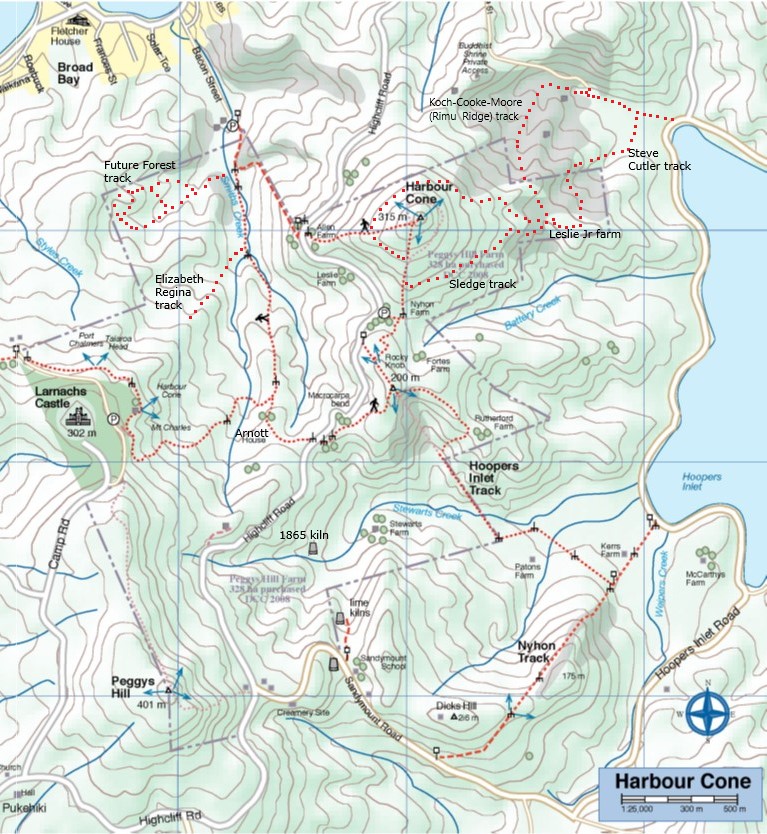
Hereweka Block map showing the marked tracks as of 2024. NB Approximate routes only for the new Around Harbour Cone track, the “Leslie loop” (Steve Cutler & KCM Rimu Ridge tracks), the Future Forest track, and the Elizabeth Regina track.

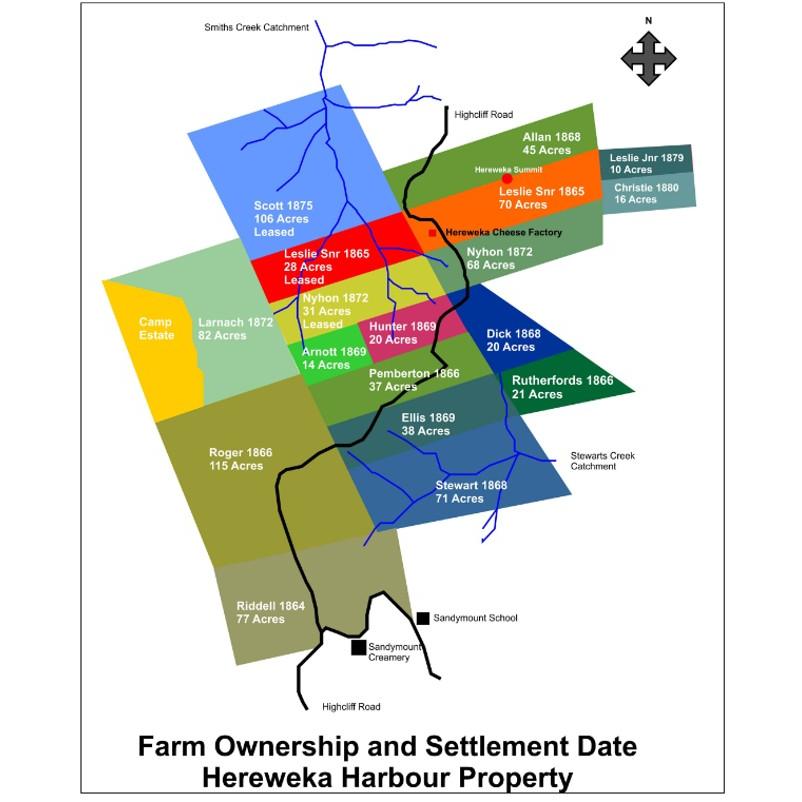
Most of the Peninsula was in the Otago Block purchased from Kai Tahu in 1844.  This isolated, steep, and heavily bushed land around Harbour Cone was subdivided in 1863. Highcliff Road was developed between Pukehiki and Portobello from about 1867 to 1869, providing access across the block.  Settlers, mainly Scottish, gradually bought sections and cleared the thick bush for their small dairy farms. Cattle could feed themselves by browsing the native bush, unlike sheep which needed short pasture.  The farmers planted macrocarpas for shelter around their homesteads – each clump of trees still marks an old house site – and built impressive drystone boundary walls.

Cows were kept under cover in byres overnight, as they had been in Britain.  Herds averaged around 20 cows, because you could only keep as many cows as the family could hand milk.  Cream was hand-churned into butter, sold in Dunedin to provide the family’s income. Skim milk was fed to pigs, and hens provided eggs.

James McDonald opened three lime kilns at Sandymount from 1865 onwards. Apparently the burnt lime produced was unsuitable for agriculture and was used for making cement. By 1882 the kilns were uneconomic, although they were occasionally reopened until 1939.

From 1872 businessman and later MP William Larnach developed a house and model farm at “The Camp”, employing a number of local tradesmen and farm workers.  His importation of stud Ayreshire and Alderney cows was instrumental in improving the Peninsula dairy industry.

In 1877 a dozen farmers formed a cooperative cheese factory, based at Capt William Leslie Sr’s property. This was successful but the venture ceased after the factory was destroyed in a major bush fire on 14 October 1881.

Home dairies were less important after 1893 when the Taieri & Peninsula Milk Supply Company, managed by local settler Walter Riddell, opened Sandymount Creamery. Farmers carried their milk to the Creamery in the morning, exchanged news with their neighbours,  and returned home with the skim milk. This Creamery  was supplied by up to 30 farmers and processed as much as 9000 litres of milk daily. Frozen butter was exported to Britain. The steady income kept these small dairy farms viable for another generation.

Portobello was the main settlement, served by ferries to Port Chalmer and Dunedin, but Sandymount also became a local centre. Sandymount School opened in 1870,  with classes held for the first two years in rooms at Walter Riddell’s house, and closed in 1949.  A Post Office was situated at Sandymount or Pukehiki from 1876 until 1952.

During the first half of the 1900s, dairy farming became uneconomic.  The dozen or so small dairy farms were gradually bought up by two local families, the Stewarts and the Nyhons, and converted to sheep farming.  In 1980 the Maori corporation Akapatiki A Block amalgamated both properties and ran the farm from Roger’s homestead.

The DCC bought the Hereweka Block in 2008 for public use and recreation.  It is managed by the Hereweka Harbour Cone Management Trust, leased out to farmer Brendon Cross  who runs sheep and some cattle.

Image004

Prepared by  Jane Bruce

Background Information for Wingatui Viaduct Taioma Hike

Thanks first to Ross who provided books and information for our hike today (20/8/2025). He was a wealth of information and was able to tell me a little about his job as Railway Inspector.  In the days when there was very little health and safety, Ross and his team had the task of checking for faults and problems every 6 months all the way along the line to Alexandra and inspecting every nut bolt and joint on the Otago Central Railway line every 5 years. This  included walking a narrow plank underneath structures like the Viaduct we are looking at today, with nothing to hold on to but a thin wire. This  could take up to two weeks on a structure as big as this one.

The bridge towers sit on rollers to allow for the expansion and contraction of the metal structure. At one point the abutment on the Parera end moved inwards through natural land movement which left no room for expansion so it became necessary to cut and shorten one of the spans. Roman numerals would be stamped on the piles of the smaller bridges to indicate the depth of the piles.

There are 21 bridges between Wingatui and Pukerangi and 86 between Wingatui and Clyde not counting the smaller bridges of which there are at least another 20. All bridges and tunnels have a number.

In 1878 a survey for the proposed railway construction was completed the goal being to serve the gold mining industry initially but it was 5 years later with the gold rush waning a second commission came to the conclusion that the agricultural and pastoral needs of the province plus other mining potential (18 collieries and  possible zinc, copper, silver, mercury mining) would justify a rail link

Construction began and by the early 1880s there were as many as 700 men working on the Hindon  section from Mullocky Gully to Deep Stream. By 1884 – 5 yrs after the first sod was turned the 12.5km of formation comprising  the Wingatui and Mullocky sections were completed.

Accidents were common, the nearest doctor, Dr McCaw, lived at Mosgiel and a call meant a trip on horseback over rough tracks and through fords in the Taieri River. As the quantities of drugs and dressings that could be carried were limited, caches of medical supplies were provided in government huts  along the construction route.

In 1880, a one-roomed school  6.8 x7.3 metre, was built beside the line midway between Mullocky Gully and Parera. It catered for 30-40 pupils for 5 yrs but had neither blackboard nor fireplace.

Mullocky Gully was thought to be named after  one Donald Malloch who with his brother John delivered mail fortnightly from Waikouiti to the Manuherakia on horseback. Early in his career he got hopelessly lost between Shag Point and Strath Taieri and nearly died before finding shelter in a shepherd’s hut.  Thereafter, the gully concerned became known as ‘the place where Malloch got lost’ subsequently mutating to “Mullocky Gully” (Hocken Library) Other references  refer to a  James Malloch who was working in the area from as early as 1861 – same man? However “mullocky” is also the waste material  left after ground had been worked over.

PARERA   Refers to the rare and endangered native Grey Duck which  resembles the introduced common female Mallard and is often confused with it.  Pure Grey Ducks are rare as many have become hybridised with the Mallard. Pure Grey Ducks have grey feet, the Mallard and hybrid Grey have  orange and plumage differs. Male Grey Ducks are simply larger than the female whereas the male Mallard has much more flamboyant plumage.
Be on the lookout.  We are assuming Parera and Duck Tunnel are named after the Grey Duck.

References:  Over The Garden Wall; Otago Central Railway 1879-1990; From Sea to Silver Peaks; Hocken Library

Cheers
Maria Macnee