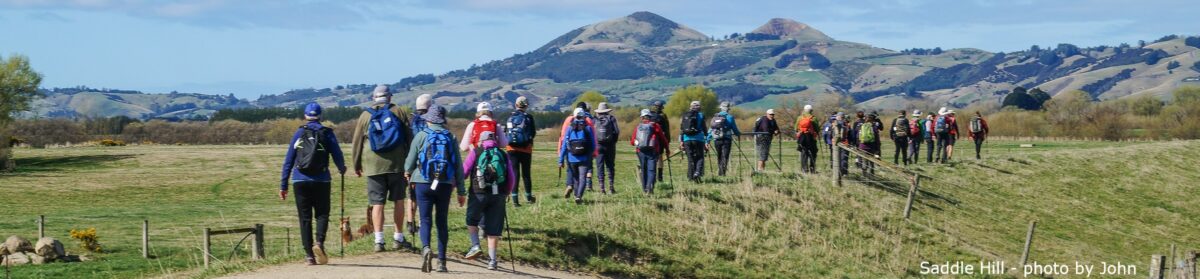
Thanks first to Ross who provided books and information for our hike today (20/8/2025). He was a wealth of information and was able to tell me a little about his job as Railway Inspector. In the days when there was very little health and safety, Ross and his team had the task of checking for faults and problems every 6 months all the way along the line to Alexandra and inspecting every nut bolt and joint on the Otago Central Railway line every 5 years. This included walking a narrow plank underneath structures like the Viaduct we are looking at today, with nothing to hold on to but a thin wire. This could take up to two weeks on a structure as big as this one.
The bridge towers sit on rollers to allow for the expansion and contraction of the metal structure. At one point the abutment on the Parera end moved inwards through natural land movement which left no room for expansion so it became necessary to cut and shorten one of the spans. Roman numerals would be stamped on the piles of the smaller bridges to indicate the depth of the piles.
There are 21 bridges between Wingatui and Pukerangi and 86 between Wingatui and Clyde not counting the smaller bridges of which there are at least another 20. All bridges and tunnels have a number.
In 1878 a survey for the proposed railway construction was completed the goal being to serve the gold mining industry initially but it was 5 years later with the gold rush waning a second commission came to the conclusion that the agricultural and pastoral needs of the province plus other mining potential (18 collieries and possible zinc, copper, silver, mercury mining) would justify a rail link
Construction began and by the early 1880s there were as many as 700 men working on the Hindon section from Mullocky Gully to Deep Stream. By 1884 – 5 yrs after the first sod was turned the 12.5km of formation comprising the Wingatui and Mullocky sections were completed.
Accidents were common, the nearest doctor, Dr McCaw, lived at Mosgiel and a call meant a trip on horseback over rough tracks and through fords in the Taieri River. As the quantities of drugs and dressings that could be carried were limited, caches of medical supplies were provided in government huts along the construction route.
In 1880, a one-roomed school 6.8 x7.3 metre, was built beside the line midway between Mullocky Gully and Parera. It catered for 30-40 pupils for 5 yrs but had neither blackboard nor fireplace.
Mullocky Gully was thought to be named after one Donald Malloch who with his brother John delivered mail fortnightly from Waikouiti to the Manuherakia on horseback. Early in his career he got hopelessly lost between Shag Point and Strath Taieri and nearly died before finding shelter in a shepherd’s hut. Thereafter, the gully concerned became known as ‘the place where Malloch got lost’ subsequently mutating to “Mullocky Gully” (Hocken Library) Other references refer to a James Malloch who was working in the area from as early as 1861 – same man? However “mullocky” is also the waste material left after ground had been worked over.
PARERA Refers to the rare and endangered native Grey Duck which resembles the introduced common female Mallard and is often confused with it. Pure Grey Ducks are rare as many have become hybridised with the Mallard. Pure Grey Ducks have grey feet, the Mallard and hybrid Grey have orange and plumage differs. Male Grey Ducks are simply larger than the female whereas the male Mallard has much more flamboyant plumage.
Be on the lookout. We are assuming Parera and Duck Tunnel are named after the Grey Duck.
References: Over The Garden Wall; Otago Central Railway 1879-1990; From Sea to Silver Peaks; Hocken Library