 09/07/2025. Peak Bagging from Cedar Farm. Grade 4. Trampers. Leaders: Sarah McCormack and Ross Davies.
It wasn’t the best of days; it wasn’t the worse of days. It was a day you might stay home in the warm, or it was a day you might go out peak bagging.
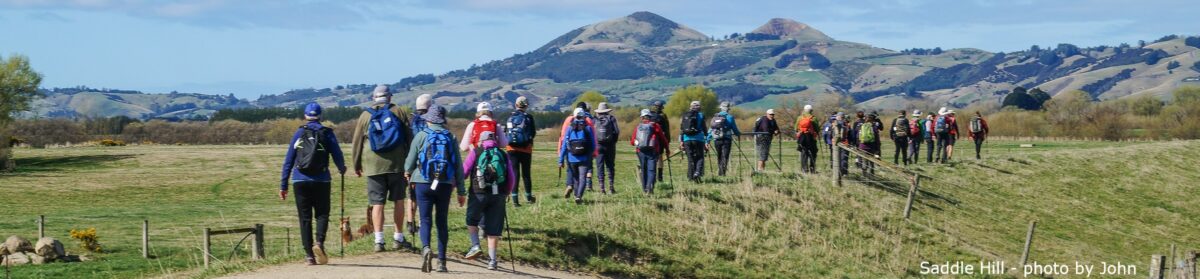
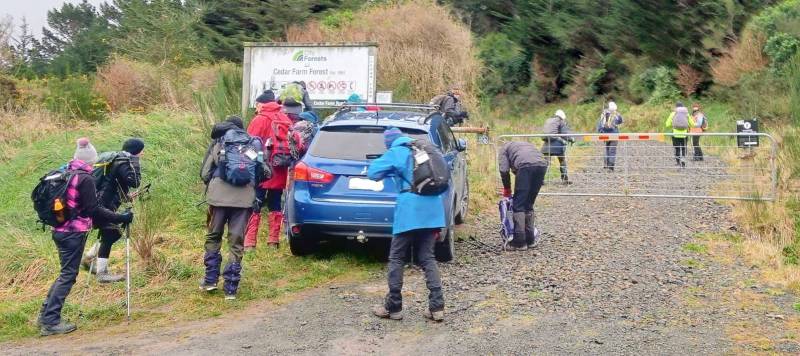
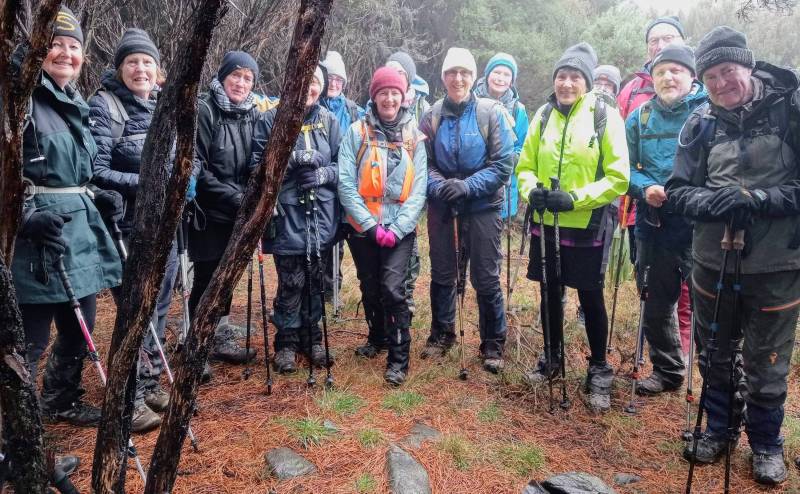
16 of us chose to turn up for a day of the latter, bagging peaks surrounding Cedar Farm overlooking Port Chalmers. We parked up at the entrance off Blueskin Road and donned most of the clothes we had and headed off up the service road at 9:45am. It was foggy and chilly and the uphill start was slow to warm us.
For the uninitiated, peak bagging is the activity of climbing a collection of summits. Serious peak baggers follow lists with criteria. And true peak baggers will not be deterred by wind or cloud or cold or absence of views. So this was a good day for finding out whether we were. It was miserable beside the dam, so we plunged into the pine forest where the wind wasn’t, and where the ground was dry enough. Morning tea was declared at 10.15am and hot drinks were drunk.

Then it was on, upwards through the pine forest. There wasn’t a track, but the going was open and the pine needles soft and it was a pleasant climb.

Soon enough we reached the top of Mt Martin, at 478m our first peak. The only view was of the inside of the cloud it was inside.

From here we sidled west, to pick up the track that lead us to the top of Mt Cutten 530m, and bagged peak #2. Still in the cloud.

From here, we descended the way we’d come up, except we continued north on the track, down to the creek that drains Cedar Dam.

Then across that saddle, and on up the other side towards Mt Kettle. Once up past the scrambly section,

we stopped for lunch in the shelter of the ridge at 12.30pm.
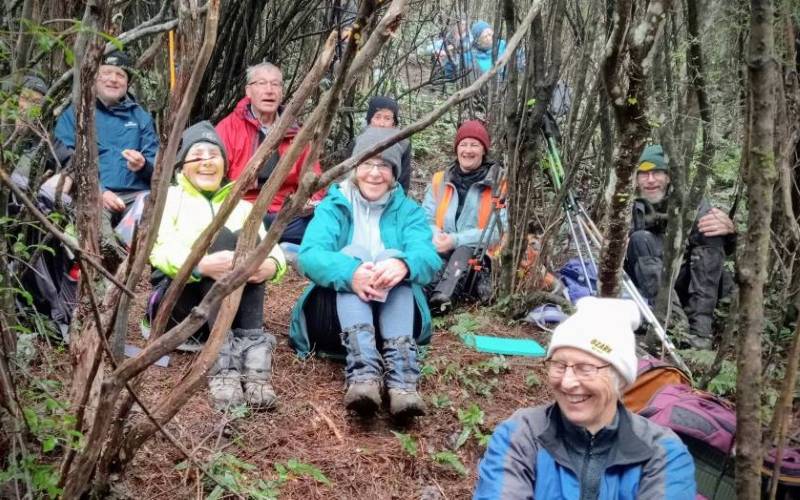
We didn’t take too long for lunch, and it wasn’t long after we restarted that we reached the top of Mt Kettle (545m) at 1pm.
After a bit of rubbish collection, we started down the rocky ridge to the east, more exposed to the weather, but also getting some glimpses of views through the clouds. We were looking over Port Chalmers and the harbour and the peninsula and some even reckoned they could see Victory Beach.

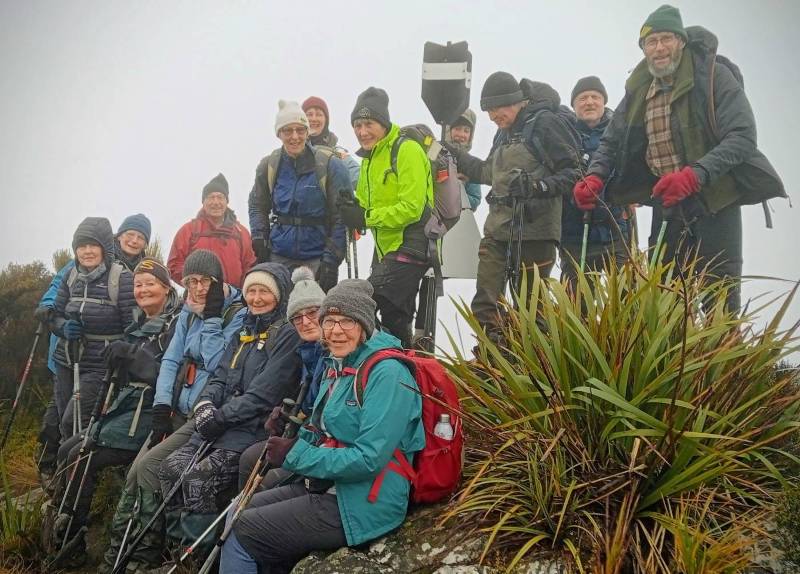
Back down in the forest we reached a saddle and then it was up again, in more pine forest so relatively sheltered. Above the pines we were more in the open and we were back in the cold wind. With most of the climb behind us, we were soon enough on top of peak #4, Mihiwaka 561m at 2.05pm. This one had the bonus of a real trig, but no view and we didn’t stay long.
We retraced our track back down to the saddle, then down to the service road and back down to the cars at 2:50pm. It wasn’t a day for lingering. It was an interesting and challenging tramp on sometimes rough tracks, with goals reached. It was a successful day of peak bagging with good company.
Stats: distance 9km, total elevation gain 500m, walking time 3hrs 10 minutes.
Ross and Sarah
Peak bagging notes from Ross.
Peak bagging is defined as the activity of climbing multiple peaks, often with the goal of reaching the summit of a predetermined list of peaks or within a specific region. It all began with Sir Hugh Munro creating a list of all the Scottish peaks over 3,000 ft (914.4m) in the late 1800s. These are now called Munros, and there are 282 of them and climbing all 282 is called ‘completing a round’ and more than 7,500 people have reported completing a round! Other classification schemes in Scotland include Corbetts 2,500 to 3,000 ft (762–914 m) and Grahams 2,000 to 2,500 ft (610–762 m). Then there are Donalds in the Scottish Borders that are hills that are at least 2,000 feet (610 meters) high, located south of the Highland Boundary Fault – that might also be Grahams or Corbetts. Plus, all of these may be some of the 1,556 Marilyns in Great Britain because 1,219 of the Marilyns are in Scotland. A Marilyn is any hill within Great Britain with a prominence of 150 metres or more above surrounding land. Bagging 1,000 Marilyns would get you into the Marilyn Upper Hall of Fame to join the 140 already there. It is of course mad, competitive and obsessive, but it sure as heck gets lots of people out walking in lots of places, including on days they mightn’t otherwise be out and about.
The patron saint of peak bagging might be George Mallory who died trying to climb Mount Everest in 1924. He waxed philosophically about why one might want to climb Mount Everest, and his comments got summed up as “…because it’s there…” Perhaps that’s what peak bagging is about? Because they’re there?
Link to background information and earlier tramps and hikes in the same area.