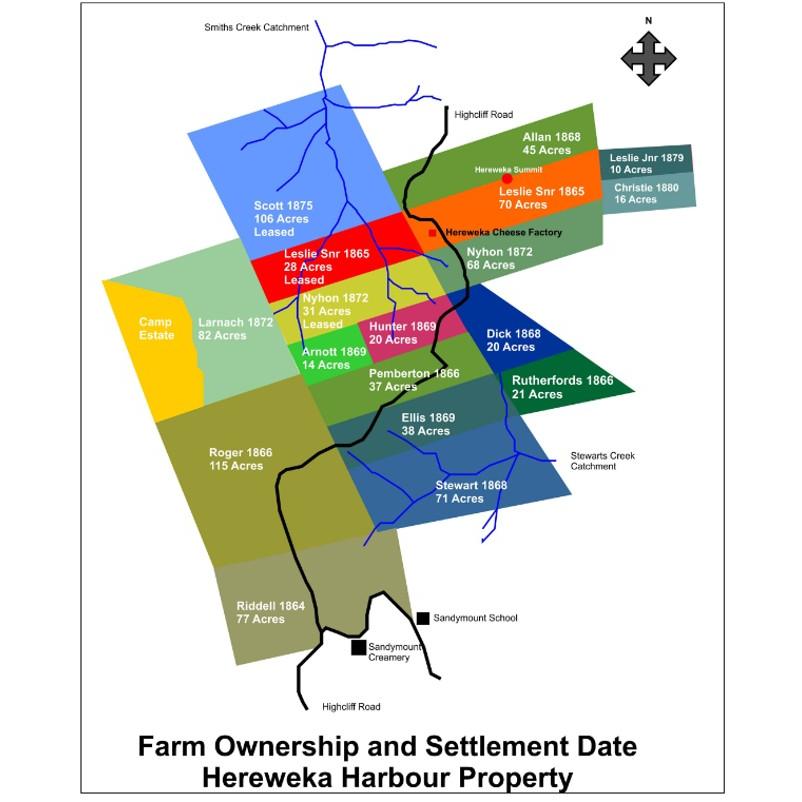
Most of the Peninsula was in the Otago Block purchased from Kai Tahu in 1844. This isolated, steep, and heavily bushed land around Harbour Cone was subdivided in 1863. Highcliff Road was developed between Pukehiki and Portobello from about 1867 to 1869, providing access across the block. Settlers, mainly Scottish, gradually bought sections and cleared the thick bush for their small dairy farms. Cattle could feed themselves by browsing the native bush, unlike sheep which needed short pasture. The farmers planted macrocarpas for shelter around their homesteads – each clump of trees still marks an old house site – and built impressive drystone boundary walls.
Cows were kept under cover in byres overnight, as they had been in Britain. Herds averaged around 20 cows, because you could only keep as many cows as the family could hand milk. Cream was hand-churned into butter, sold in Dunedin to provide the family’s income. Skim milk was fed to pigs, and hens provided eggs.
James McDonald opened three lime kilns at Sandymount from 1865 onwards. Apparently the burnt lime produced was unsuitable for agriculture and was used for making cement. By 1882 the kilns were uneconomic, although they were occasionally reopened until 1939.
From 1872 businessman and later MP William Larnach developed a house and model farm at “The Camp”, employing a number of local tradesmen and farm workers. His importation of stud Ayreshire and Alderney cows was instrumental in improving the Peninsula dairy industry.
In 1877 a dozen farmers formed a cooperative cheese factory, based at Capt William Leslie Sr’s property. This was successful but the venture ceased after the factory was destroyed in a major bush fire on 14 October 1881.
Home dairies were less important after 1893 when the Taieri & Peninsula Milk Supply Company, managed by local settler Walter Riddell, opened Sandymount Creamery. Farmers carried their milk to the Creamery in the morning, exchanged news with their neighbours, and returned home with the skim milk. This Creamery was supplied by up to 30 farmers and processed as much as 9000 litres of milk daily. Frozen butter was exported to Britain. The steady income kept these small dairy farms viable for another generation.
Portobello was the main settlement, served by ferries to Port Chalmer and Dunedin, but Sandymount also became a local centre. Sandymount School opened in 1870, with classes held for the first two years in rooms at Walter Riddell’s house, and closed in 1949. A Post Office was situated at Sandymount or Pukehiki from 1876 until 1952.
During the first half of the 1900s, dairy farming became uneconomic. The dozen or so small dairy farms were gradually bought up by two local families, the Stewarts and the Nyhons, and converted to sheep farming. In 1980 the Maori corporation Akapatiki A Block amalgamated both properties and ran the farm from Roger’s homestead.
The DCC bought the Hereweka Block in 2008 for public use and recreation. It is managed by the Hereweka Harbour Cone Management Trust, leased out to farmer Brendon Cross who runs sheep and some cattle.
Prepared by Jane Bruce