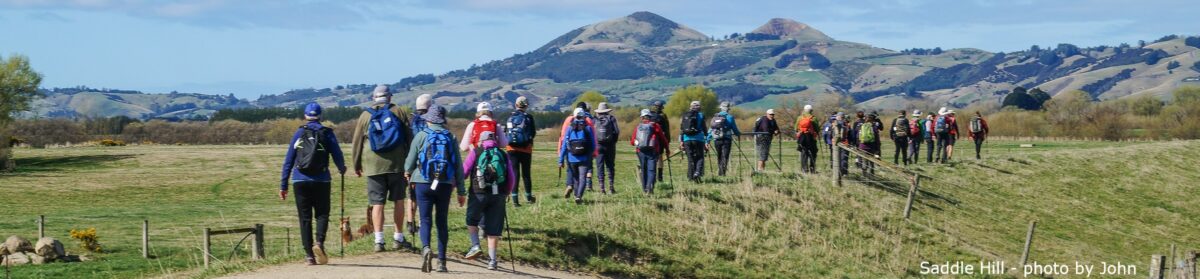
| “Always in the big woods when you leave familiar ground and step off alone into a new place there will be, along with the feelings of curiosity and excitement, a little nagging of dread. It is the ancient fear of the unknown, and it is your first bond with the wilderness you are going into”. Wendell Berry |
Context |
| Rule 22 of the club Constitution makes it clear that members must be familiar with and follow The Trip Guidelines. The Trip Guidelines are comprised of 3 parts: 1. How to run a trip (this document) 2. Trip Leaders and the Web team 3. Trip Programme information |
| The component Trip Guidelines are for all members and those selected to lead, organise and guide the group, so all club members must become familiar with them. |
| Guidelines need to be flexible for the conditions; whether on top of Mt Charles in fog, heading south on the Maungatua into a SW change, undertaking a walk in town to admire street art or walking to the end of the day out with clear views of the parked cars in the distance. |
Pre-trip – Leaders should: |
| Note they have the full backing of the Committee and are considered to be the final decision makers of who participates on the day of the walk. |
| Undertake a recce. It is recommended you familiarise yourself with the Trip Grading system developed by the club so that following the recce the Grade for the walk can be confirmed. Assess that the walk would meet the expectations and capabilities of the group. |
| Note that the Club’s 3rd Personal Locator Beacon (PLB) is recommended to be used for recces, available from Phil Keene (txt 021 035 8551 or [email protected]). In addition Annette MacRae (txt 027 486 1527 or [email protected]) or Dave Mellish (txt 021 102 9890 or [email protected]) should be advised of where and when the recce is being held in case the PLB is activated. This applies if any club PLB is used. Both the trampers and hikers each have a PLB bag and it is practice to get the PLB bag at the end of the prior week’s walk. |
| Note reimbursement for fuel for undertaking a recce is possible where the trip passenger fee is $10.00 per person and over. This can be requested by sending an email to the club treasurer at [email protected] confirming where and when the recce was undertaken. Please provide the recipients bank a/c details. |
| Note that members in town travelling to a start point in town, or north, with club transport will pay a minimum of $5.00 per person. Note that the 3 main meeting points in Dunedin are: – Bayfield Park for Peninsula walks – Otago Yacht Club for West Harbour walks; and – Woodhaugh Gardens for trips North of the city. |
| Confirm access and car parking is available and prior permission of landowners is obtained if required. |
| Assess appropriate spots where tea and lunch breaks will be held; it is useful to know if cell phone coverage is available. |
| If the walk is on public land, track alerts can be checked on DOC/DCC websites. If on farmland, check with the owners if there are any particular stock matters to be aware of or other matters like electric fencing. For landowners details, contact the relevant trip co‑ordinator for your group. |
| Use all of the communication channels within the club to advise cancellation or changes to trips or starting times. See parts 2 and 3 for more detail. |
| Know that if inclement weather threatens they have the freedom to still meet and change the trip as long as appropriate timely advice can be relayed to the club members. Search Trip Destination Summaries on the club website for options. |
| Contact [email protected] if a key is required for access to a DCC reserve or facility. |
| Contact DCC 3 Waters, 95 Dukes Road North, Mosgiel, for access key to ‘Ship at Anchor’. |
Trip day |
| Leaders should check the latest weather information as early as possible. |
| Leaders should ensure the group has essential equipment such as the club PLB and for trampers the two way hand held radios (and know how to use them; a laminate of how the radios work is in the PLB bag) and hi-vis vests. Apart from those items both the trampers and hikers PLB bags should also contain the false alarm phone number, a safety alert paper, a wrist splint and tape, pen and paper and the membership list. Please let the club Secretary know if anything is missing. |
| Leaders should wear hi-vis vests at all times. and must carry whistles (1 blast for everyone to stop, 3 blasts for emergency) as well as a torch and pen and paper (in the PLB bag). |
| Members should ensure they have breakfasted well, have plenty of water, pack labels with medical and emergency contact details that are up to date. Also bring the nominated trip cash to pay drivers. |
| Drivers of vehicles providing transport should ensure their vehicles have a current warrant of fitness. |
| Members should note that drones or pets are not permissible. |
| Leaders should ensure everyone has a ride, as well as drivers have directions and know where to park. Check the number of cars expected to arrive at the starting point. |
| Members must ensure they are in good health and advise leaders of any existing condition that may require access to medication (e.g. epi-pen) on the trip. |
| Leaders should introduce themselves to guests and briefly outline the options for the day and get an indication of the guests ability in the field as well as any medical information they should be aware of. |
| Leaders and members should have a shared concern for the group’s safety including the limits of the group, as well as time and the weather. |
| Leaders should know that adjusting the day’s goal to suit the conditions and the groups ability is supported by the Committee. |
| Everyone should keep an eye out for anyone starting to stumble or slip. This is an early indicator of tiredness or a possible medical condition. |
| Leaders must ensure that if visibility or weather is poor, all members of the group must be within sight. Bad weather combined with the terrain can increase anxiety and tiredness that increases risk. |
| Leaders should ensure there are regular stops to re-group and to check everyone is present. Aids such as PLB, radios, cell phones should not result in over confidence or a lessening of good tramping practice that results in spread out groups. If necessary, slower walkers should be placed at the front of the group. Generally the group should keep together and walk at a pace that achieves this. For large groups, such as the monthly combined walk, there must be leaders and tail-end-charlies nominated for both trampers & hikers. |
| In no circumstances should anyone be allowed to walk on their own, even if returning to a vehicle. |
| If someone leaves the track for a toilet stop, tell someone and leave the pack on the track. |
| Clear instructions on direction and stops must be shared and known by the leaders at the front and rear of the group. |
| Leaders should ensure that all track intersections are appropriately managed to ensure no wrong turns are made. Similarly if say a large tree or track damage blocks the track. These are appropriate times to recount the number of members present. |
| If the group is large, experience has shown a volunteer can be nominated to be in the middle of the group to assist by ensuring communication is effectively relayed (ratio of 1:12). Another option is to buddy up in pairs, especially in inclement weather or rough terrain. |
| Members should ensure leaders are kept informed if they are feeling unwell or need rest or support. |
| As a general rule, strong river currents should NOT be attempted. Turn back. |
| On roads where there is no footpath or wide verge, move in single file facing on-coming traffic or keep to the outside edge of blind right hand corners. The front and rear leaders must have the hi-vis vests on. The shortest route must be taken across roads and if necessary the group split into smaller groups when crossing. No straggling long lines! |
| Leaders should ensure everyone knows where to meet for coffee/tea ‘n’ cake or ice cream. Contact the venue in advance, if necessary. |
Medical |
| All members are to carry a small personal kit of a few plasters, painkillers, insect repellent and personal medication (if required on a trip). A wrist splint and tape is provided in the bag that holds the group PLB. |
|
General advice: |
What to take: |
| Clothing and equipment: Sensible clothing – wear layers to cope with changing weather. Not jeans. Always carry a waterproof jacket/parka, warm hat and gloves. Waterproof over-trousers are also useful. Sunhat/sunscreen in summer, sun-glasses. A light-weight day pack – don’t overload it! |
| Footwear with good tred – boots recommended but for some walks walking shoes are okay. |
| A spare pair of shoes, in a separate bag, to use in car transport after the walk. |
| Food and drink: Take adequate food for morning tea and lunch, plus something extra (e.g. a muesli bar) for emergencies. It is essential to have adequate drinks for the conditions, e.g. a plastic bottle for water, and/or a thermos for a hot drink if desired. Sip water frequently as you walk. |
Post trip – Leaders should: |
| Provide a short write up to the Webteam. If the walk has been on private land acknowledge this in the write up, and if not possible on the day contact the landowner to say thanks on behalf of the Club. |
| Provide feedback, as appropriate, to the President/a committee member on prospective members |
| Provide information to the President and/or Secretary of any incident that eventuated on the trip. |
| Provide details of new property contacts to the Webteam to update the Permissions database. |
Prepared by Phil Keene – August 2026